
Huelva Guide: Doñana, Beaches, and the Columbus Landmarks
Huelva is the Andalusian province that looks out towards both the Atlantic and America. It was from here that Columbus’s caravels set sail in 1492, changing — for better and for worse — the course of history. But Huelva is far more than the Discovery: it’s Doñana, Europe’s most important wetland; it’s the unspoilt coastline of Mazagón and Punta Umbría; it’s the Sierra de Aracena with its cork oak dehesas and its acorn-fed Iberian ham; it’s Jabugo ham and the wines of El Condado.
It is the westernmost province of Andalusia, bordering Portugal to the west, Extremadura to the north, Seville to the east, and the ocean to the south. And despite having some of the most valuable natural landscapes on the continent, it remains the Andalusian province with the least international tourism. For anyone looking for uncrowded places, that’s good news.
Doñana: Europe’s Last Great Wetland
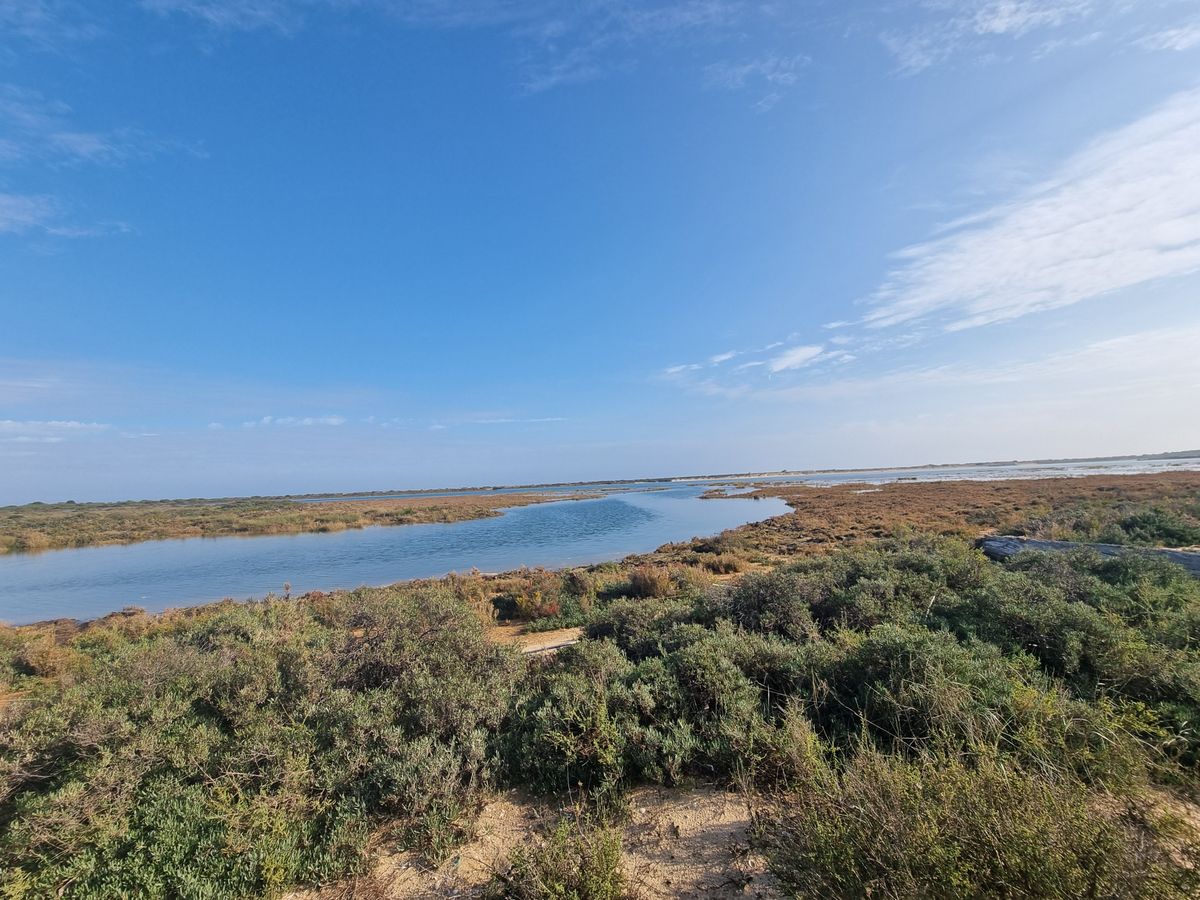
Doñana National Park is Huelva’s most emblematic protected area, shared with the neighbouring provinces of Seville and Cádiz. Its more than fifty thousand hectares of marshes, shifting dunes, hunting reserves, and unspoilt beaches are an essential stopover for six million migratory birds each year. Imperial eagles winter here and flamingos nest.
Access to the park is not free: it can only be visited with authorised guided tours that depart from various visitor centres. The most accessible from Huelva are the El Acebuche Visitor Centre (near Matalascañas) and the La Rocina Visitor Centre (near El Rocío). Tours are conducted in adapted all-terrain vehicles and last between three and four hours. You need to book in advance, especially in spring and autumn, which are the best seasons for birdwatching.
The village of El Rocío is worth visiting even if you don’t coincide with the pilgrimage. The streets are made of sand (there’s no tarmac here), the houses have porches and large gates for horses, and the Hermitage of the Virgen del Rocío — a white colossus from the mid-20th century that dominates the marshes — is the spiritual heart of one of the largest pilgrimages in the world. The El Rocío pilgrimage takes place fifty days after the end of Holy Week and brings together over a million pilgrims. If you’re into large-scale folklore and devotion, it’s impressive. If not, simply avoid those dates.
The Beaches of Huelva
Huelva’s coastline is different from Cádiz or Málaga. Here the Atlantic is more open, the tides more noticeable, and the sand finer and more golden. The Huelva coast has one hundred and twenty-two kilometres running from the mouth of the Guadiana (the border with Portugal) to the mouth of the Guadalquivir (the boundary with Cádiz).
- Matalascañas: the best-known beach in the province. More than five kilometres of fine sand with Doñana National Park at its back. In summer it fills up, but you only need to walk fifteen minutes towards the dunes to find almost deserted areas. At sunset, with the silhouette of the Coto de Doñana and the sun going down over the Atlantic, it’s one of the finest sunsets on the Andalusian coast.
- Punta Umbría: a fishing village turned family holiday destination. Its beach, with light-coloured sand and calm waters (relatively, because the Atlantic always has some swell), is ideal for children. The chiringuitos right on the beach boil prawns from the estuary, which sounds simple but when you try them you understand that it’s enough.
- El Rompido: between the Piedras and Odiel rivers, a sand spit over ten kilometres long (the Flecha de El Rompido) that juts into the ocean and is only accessible by boat from the village. It’s an almost virgin beach with no buildings.
- Islantilla and La Antilla: urban beaches with a seafront promenade and plenty of leisure options. If you’re looking for atmosphere and amenities, they work. If you’re looking for wild nature, keep heading towards Mazagón or El Rompido.
The Columbus Landmarks
Huelva is inseparable from the discovery of America. Columbus didn’t set sail from Cádiz or Seville: he set sail from Palos de la Frontera.
The Monastery of La Rábida (Palos de la Frontera) is a small 14th-century Franciscan convent where Christopher Columbus found support from Friar Juan Pérez and the monastery’s physician when the rest of the kingdom ignored him. The monastery is modest compared to the great Andalusian cathedrals, but it is one of the most historically important sites in the world: the voyage that changed the world’s conception of the planet was forged here. Next to the monastery is the Wharf of the Caravels, a full-size recreation of the three ships (the Santa María, the Pinta, and the Niña), with an interpretation centre about the voyage.
In Moguer, a few kilometres away, stands the Monastery of Santa Clara, where Columbus held a vigil before setting sail. Moguer is also the birthplace of Juan Ramón Jiménez, Nobel Prize in Literature, and his childhood home can be visited.
Palos de la Frontera preserves the church of San Jorge, where on 23 May 1492 the Royal Decree was read ordering the inhabitants of Palos to provide two caravels for the expedition. The baptismal font where the sailors received the sacraments before setting sail is inside.
The whole complex can be covered in a morning. If you go in August, the heat is punishing and there’s little shade, so plan your visit for first thing.
The Sierra de Aracena and Jabugo Ham
In the north of the province, on the border with Extremadura, rises the Sierra de Aracena y Picos de Aroche, an area of cork oak dehesas, whitewashed villages with castles, and an Atlantic microclimate that makes it greener than the rest of Andalusia. This is where the Iberian pigs that produce Jabugo ham — probably the finest ham in the world — are raised.
The villages of the sierra form a circular route that can be done by car in two or three days:
- Aracena: the sierra’s capital, with a colonnaded main square, a ruined Templar castle at the top, and the Gruta de las Maravillas, a cave with karst formations of stalactites and stalagmites that you visit on a guided tour lasting about forty-five minutes.
- Almonaster la Real: a 9th-century mosque preserved almost intact inside the village castle. It is one of the few Andalusí mosques that was neither demolished nor later converted into a church.
- Jabugo: the epicentre of Iberian ham. The most prized pieces are cured here, in natural drying sheds that harness the sierra’s microclimate. The Cinco Jotas company (Sánchez Romero Carvajal) offers tours of its cellars with tastings. The cellars are old and smell of ham in a way that stays with you the rest of the day.
- Cortegana: a well-preserved medieval castle and one of the best viewpoints in the sierra.
- Alájar: a whitewashed village at the foot of the Peña de Arias Montano, a vertical rock formation with a 16th-century chapel at the top and views that take in half the natural park.
In autumn, during the montanera (October to January), the Iberian pigs graze in the dehesas eating acorns, and the image of the pigs under the cork oaks, with the autumn colours on the deciduous leaves of the chestnut and oak trees, is a scene that doesn’t look Andalusian. It looks like Extremadura, or from further north.
Huelva Gastronomy
Huelva’s cuisine is a mix of sea and mountains that explains the personality of the province by itself:
- Acorn-fed Iberian ham from Jabugo: it needs no introduction. What is worth knowing is that 100% acorn-fed Iberian ham is only produced in this region and in parts of Extremadura. The pigs are raised free-range, fed on acorns during the montanera, and the curing lasts a minimum of three years. It’s expensive and it’s perfect.
- White prawns from Huelva: the Huelva prawn is smaller and tastier than the Mediterranean red prawn. It’s fished off the Huelva coast and cooked in the simplest way possible: boiled in seawater or grilled with coarse salt.
- Chocos con habas: cuttlefish stewed with broad beans, a classic surf-and-turf combination from the coast. Simple and hearty.
- Wines of the Condado de Huelva: the Condado de Huelva designation of origin produces quality white and fortified wines. The orange wine of El Condado (a sweet wine macerated with bitter orange peel) is a rarity worth trying.
When to Go to Huelva
The province of Huelva has character for every season:
- Spring: the best time for Doñana. The marshes are full of water, migratory birds stop over, and the park is at its most magnificent. It’s also a good time for the sierra: everything is green and in bloom.
- Summer: ideal for the beach. Temperatures on the coast are high but bearable, and the Atlantic water is warmer than on other Spanish Atlantic coasts. The sierra also works as a refuge from the heat.
- Autumn: the montanera in the sierra (October–December). The villages are quiet, the dehesa landscape with its autumn colours is beautiful, and the ham is at its prime.
- Winter: Huelva has the mildest winters in western Andalusia. The sierra can have overnight frosts, but during the day it’s pleasant.
For more destinations in southern Spain, see the guides to Seville and Cádiz, neighbouring provinces with which you share Doñana. If you’re coming from Portugal, the border with the Algarve is less than an hour away.
Frequently Asked Questions
Can you visit Doñana on your own? No. Access to the National Park is restricted and can only be done with an authorised guide. Tours are booked through concessionary companies that depart from the visitor centres. It’s advisable to book weeks in advance, especially in spring and autumn.
Do I need a car to get around Huelva? There is more public transport along the coast between Punta Umbría and Islantilla, but for the Sierra de Aracena and to move freely between areas, a car is almost essential.
Is Jabugo ham expensive? The 100% acorn-fed Iberian one is, but there are more affordable categories (50% Iberian, field-fed) that are also excellent. In the sierra’s cellars you can buy directly and prices are better than in city shops.
How many days to see Huelva? Two or three days for the coast and the Columbus landmarks. Two or three more for the sierra and Doñana. With a full week you cover the essentials at a relaxed pace.