
Córdoba Guide: The Mosque, The Courtyards, and the Jewish Quarter
Córdoba is one of those cities where it’s best to arrive without too much of a plan. The Mosque will leave you speechless — that’s inevitable — but the Córdoba that really stays with you is the one of the late afternoon: the narrow lanes of the Jewish Quarter once the sun has gone down, the scent of jasmine drifting out of a courtyard you only half-see through a half-open door, a small bar counter serving a flamenquín you won’t find in any tourist guide.
Córdoba holds three UNESCO World Heritage designations: the Mosque-Cathedral (1984), the historic centre that surrounds it (1994), and the Festival of the Courtyards (2012). Three designations in a city of just over three hundred thousand inhabitants. The sheer density of heritage here is hard to match anywhere in Europe.
The Mosque-Cathedral: the Forest of Columns
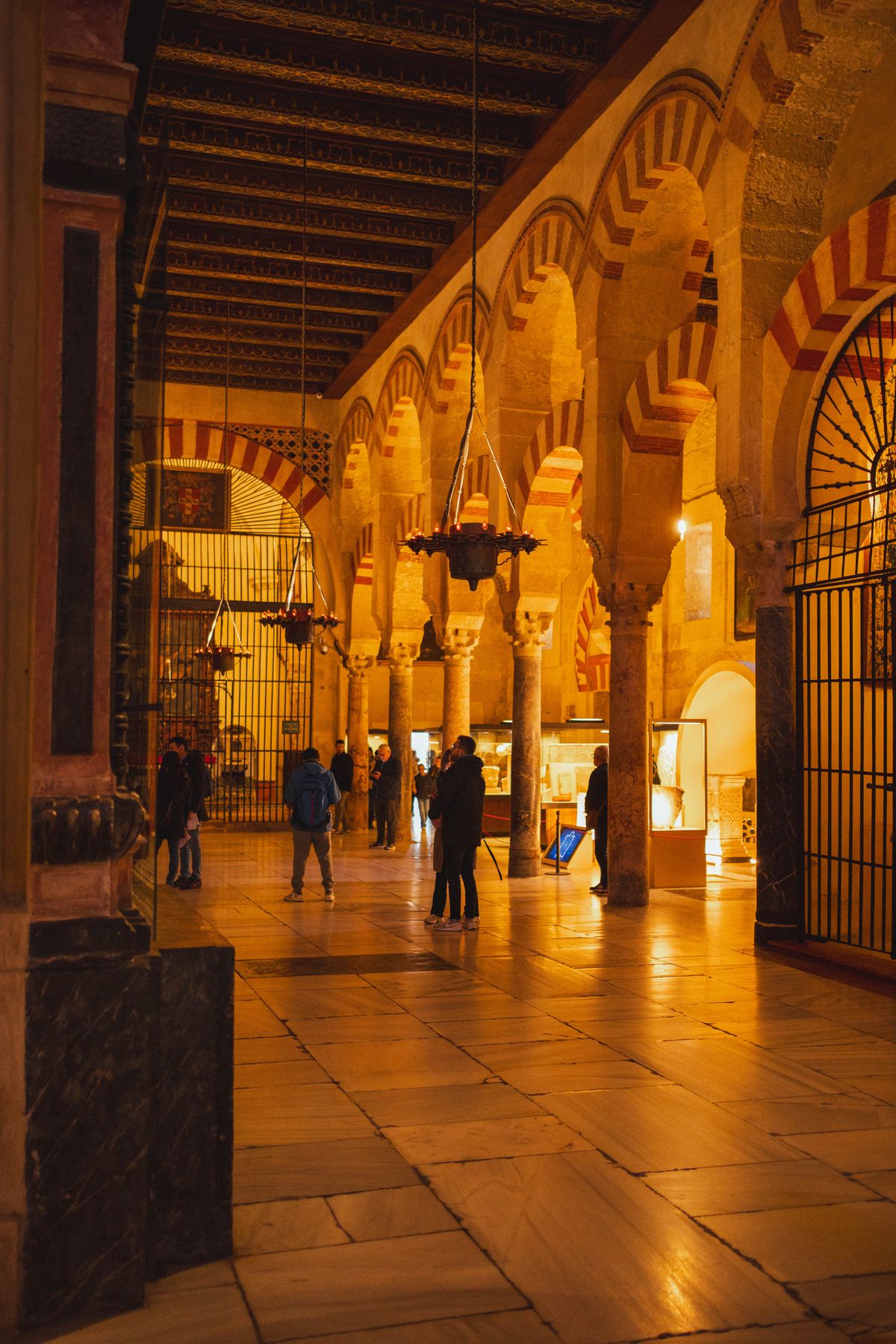
Walking through the Puerta del Perdón and coming face to face with eight hundred and fifty columns of marble, jasper, and granite is one of those experiences you remember years later. The double arcades — superimposed horseshoe arches alternating in red brick and white stone — create an optical effect of infinite depth. It’s one of those places where the architecture produces a real physical emotion, not one you fake because it’s expected.
The original mosque was begun by Abd al-Rahman I in the year 786 on top of a Visigothic basilica. Over two centuries, each caliph extended it southwards — towards the Guadalquivir — until Almanzor, at the end of the 10th century, left it at its current dimensions: twenty-three thousand square metres.
What’s most surprising about the Mosque is not its size but its orientation. All mosques face Mecca — southeast from Córdoba — but this one faces south. The most widely accepted theory is that Abd al-Rahman I, who had fled Damascus after his family was massacred by the Abbasids, wanted to replicate the orientation of the Great Mosque of Damascus, his home city. An emotional decision, not a geographical one.
In 1236 Ferdinand III the Saint conquered Córdoba and the Christians consecrated the mosque as a cathedral. For most of the Reconquest, the decision was simply to use the space as it was, adding side chapels. The dramatic turn came in 1523, when the cathedral chapter — with permission from Charles V — began building a Renaissance cathedral literally inside the mosque. Legend has it that when the emperor saw what they had done he said: “Had I known what you were doing, I would not have allowed it, for you are making what is found elsewhere and destroying what exists nowhere else in the world.”
The anecdote may be invented, but the contradiction of the Mosque-Cathedral is real: an Islamic temple with a Christian cathedral embedded in its centre. Some see it as an outrage. Others, as the most honest metaphor for what Córdoba is: layers of history that are never quite erased.
Practical tip: General admission costs €13. Monday to Saturday, from 8:30 to 9:30 am, entry is free (individual access, not in groups). If you’re interested in seeing it with the morning light coming through the stained-glass windows and without crowds, that’s the time slot. However: at 9:30 am you are politely ushered out to begin the tourist visits.
The Jewish Quarter: Getting Lost is the Idea
To the north of the Mosque stretches the Jewish Quarter, the old Jewish quarter of Córdoba. The strategy here is simple: turn off the GPS and let yourself get lost. The streets are narrow, the walls white, the ground uneven cobblestone. Every few metres a doorway appears with hanging flowerpots and a wrought-iron gate offering a glimpse of an interior courtyard.
The Synagogue of Córdoba (Calle Judíos, 20) is small — barely fifteen people fit inside — but it is one of only three medieval synagogues preserved in Spain, alongside those in Toledo. Its walls bear 14th-century Mudéjar plasterwork with Hebrew inscriptions. Entry is free for EU citizens.
A few metres away is the Casa de Sefarad, a museum dedicated to Sephardic culture that explains the history of Córdoba’s Jewish community before the expulsion of 1492. The building dates from the 14th century and is worth visiting for the architecture alone.
And then there’s the Calleja de las Flores, a short, narrow alley that ends in a small square with views of the Mosque bell tower. It’s one of the most photographed corners in Andalusia, but a warning: in high season there’s sometimes a queue to get the photo. Go first thing or last thing.
The Alcázar of the Christian Monarchs
Facing the Guadalquivir, two minutes from the Mosque, stands the Alcázar. Don’t expect an Islamic palace: it’s a 14th-century Christian military fortress, with a large parade ground, crenellated towers, and terraced gardens with ponds, orange trees, and cypresses that are the real reason to go in.
The gardens of the Córdoba Alcázar are more reminiscent of the Generalife than of a military castle. Fountains, long ponds with koi carp, precisely trimmed hedges. In summer, the temperature contrast between the street and the shade of the gardens is one of the great small pleasures of the trip.
In one of the Alcázar’s towers, the so-called Torre del Homenaje, Christopher Columbus met with the Catholic Monarchs in 1486 to present his project of sailing to the Indies via the west for the first time. The meeting did not go well: the royal advisors rejected the plan. Columbus didn’t get his yes until six years later, in the camp at Santa Fe, facing besieged Granada.
Medina Azahara: The City That Lasted Seventy Years
Eight kilometres west of Córdoba, on the slopes of the Sierra Morena, lie the ruins of Medina Azahara, the palatine city that Abd al-Rahman III ordered built in the mid-10th century. The site is enormous — one hundred and twelve hectares — though only ten percent has been excavated.
The story of Medina Azahara is the story of an ephemeral dream. Abd al-Rahman III, the first Umayyad caliph of Córdoba, ordered its construction in 936 as a symbol of his power against the Fatimids of North Africa and as a residence away from the bustle of the capital. The finest materials arrived from half the Mediterranean basin: marble from Carthage, columns from Rome, timber from Ifriqiya.
The city functioned as the political centre of the caliphate for barely seventy years. In 1010, during the fitna that disintegrated the caliphate, Berber troops sacked it and abandoned it. Within less than a century, the most dazzling city in the West lay buried.
Today you can visit the Salón Rico (or Abd al-Rahman III’s reception hall), the caliph’s great reception space. The ataurique work — the stone carving with plant and geometric motifs that covered every surface — gives you an idea of what the place was like before the sacking. The house of Yafar, the prime minister, and the aljama mosque are also preserved.
There’s a shuttle bus from Córdoba (tourist line, departs from the Cruz Roja roundabout). If you go by car, parking costs three euros. The full visit, including the interpretation centre, takes up a morning.
The Courtyards of Córdoba
If anything defines Córdoba as much as the Mosque does, it’s the courtyards. The origin of this tradition is practical: the Romans already built houses around a central courtyard with a fountain or a well to cool the atmosphere. The Arabs refined the concept, adding vegetation, running water, and an obsession with shade.
In Córdoba, the courtyard is not a luxury: it’s the centre of domestic life. Houses are organised around it, rooms open onto it, and during the hot months the whole family moves into the courtyard.
The Festival of the Courtyards is held every year for two weeks in May. Residents open the doors of their homes so anyone can come in and see their courtyards. It’s a friendly competition with prizes from the city council and a genuine neighbourhood atmosphere. If you can travel to Córdoba in May, do it.
Outside the festival dates, several courtyards are open to the public all year round:
- Palacio de Viana: twelve courtyards and a garden. Full admission costs eight euros and is worth every cent. Each courtyard has a distinct character: the Courtyard of the Orange Trees, the Courtyard of the Grilles, the Chapel Courtyard.
- Patios de San Basilio: in this neighbourhood, several residents keep their courtyards open through an agreement with the city council. Check opening times at the tourist office.
What to Eat in Córdoba
Córdoba’s cuisine is hearty and makes no apologies for it. These are the dishes you mustn’t miss:
- Salmorejo: it’s not gazpacho. Córdoba salmorejo is thicker, uses more bread and less water, and is served with chopped hard-boiled egg and diced Iberian ham on top. In Córdoba they debate whether the best is at Taberna La Montillana or Bar Santos.
- Oxtail (rabo de toro) : slow-braised for hours until the meat falls off the bone if you so much as glance at it. Generous plates, the kind that need bread for mopping up.
- Flamenquín: a roll of Serrano ham wrapped in pork loin, breaded and fried. Originally from nearby Montilla but adopted as their own.
- Aubergine with honey: fried aubergine drizzled with cane honey. Cane honey is a dark syrup made from sugar cane, typical of the Granada coast but widely used in Córdoba cooking.
For tapas, the classic area is Calle San Fernando and its surroundings. Taberna Salinas (Calle Tundidores, 3) is a century-old institution with a magnificent interior courtyard. Casa Pepe de la Judería (Calle Romero, 1) has a terrace in a secluded little square ideal for summer nights.
When to Go to Córdoba
Córdoba records some of the highest temperatures in Europe in summer. In July and August it easily tops 40°C, and by midday people vanish from the streets. If you travel in summer, plan visits for early morning and late afternoon, and do as the locals do: a long siesta.
Spring (March to May) is the perfect time. Temperatures are pleasant, the orange trees are in bloom, and if you coincide with the Festival of the Courtyards in May, the experience is complete. Autumn also works very well, with milder temperatures and fewer tourists.
In Seville, Granada, and Málaga you’ll find more Andalusian destinations to round off your route through southern Spain.
Frequently Asked Questions
How many days do I need to see Córdoba? Two full days. The first day for the Mosque-Cathedral, the Jewish Quarter, and the Alcázar. The second for Medina Azahara and the courtyards. If you only have one day, prioritise the Mosque first thing, the Jewish Quarter mid-morning, and the Alcázar in the afternoon.
Is Medina Azahara worth it or is it skippable? If you have even a passing interest in history, yes. The interpretation centre is very well done and the site helps you understand Caliphal Córdoba. If you’re just passing through and have half a day, stick to the historic centre.
Can you visit the Mosque for free? Yes, Monday to Saturday from 8:30 to 9:30 am entry is free. Groups are not allowed during that time slot and you cannot do the guided tour.
Which is the best area to stay? The Jewish Quarter is the most central and has the most atmosphere, but bear in mind that many streets are pedestrian and the car has to stay outside. If you’re travelling by car, the Avenida de la Libertad area has good hotels with parking and is a ten-minute walk from the centre.