
Cádiz Guide: Beaches, White Villages, and Carnival
The province of Cádiz is proof that not all of Andalusia is inland. Here, monument and cathedral tourism gives way to something else: the immense Atlantic, beaches that seem never to end, inland sierras dotted with white villages, sunsets that turn the sky into something that doesn’t look real, and a capital city that juts out to sea from a narrow peninsula like an anchored ship.
Cádiz has one hundred and thirty-eight kilometres of coastline, forty-four municipalities, and the Sierra de Grazalema Natural Park. But above all it has a different light. The light of the Atlantic coast is whiter, cleaner, and combined with the blue of the sea it produces a contrast that explains why so many car and perfume ads have been shot here.
The City of Cádiz: the Silver Cup
The capital has one huge advantage: being on a peninsula connected only by a narrow strip of sand, the sea is visible from almost any point. Plaza de San Juan de Dios, La Caleta, Campo del Sur, the Paseo de Santa Bárbara… If you let your guard down, you can measure every walk in kilometres of coastline.
The Cathedral of Cádiz, Baroque and Neoclassical in style, was begun in 1722 and not finished until 1838. They call it “the hundred-year cathedral.” It bears a resemblance to Havana Cathedral — the same architect, Vicente de Acero, worked on both. You can climb the Clock Tower (Torre de Poniente) for a full panoramic view of the city, the port, and the ocean.
The Barrio del Pópulo is the oldest neighbourhood in the city and one of the oldest in Europe. Three medieval arches — the Arco de la Rosa, the Arco de los Blancos, and the Arco del Pópulo — mark the entrances to what was the walled medieval town. Walking through here at sunset, when the streets empty and the piedra ostionera stone begins to reflect the orange light, is one of those unplanned moments you carry with you.
The Central Market is a must-visit even if you’re not buying anything. The building is Neoclassical and its stalls sell the best fish and seafood in the area. Out the back there’s a corridor of food stands where they fry fish to order. The cazón en adobo and tortillitas de camarones they serve here are worth the trip on their own.
The Gran Teatro Falla is the temple of the Cádiz Carnival. Its unmistakable red-brick façade is iconic. If you don’t coincide with Carnival (February), the theatre is worth visiting for its Modernist architecture alone. And if you do coincide with Carnival, everything else can wait.
The Beaches of the Costa de la Luz
The Cádiz coastline is divided into two stretches: the Atlantic coast running from Sanlúcar de Barrameda to Tarifa, and the Mediterranean stretch that starts at Tarifa and continues towards Málaga. Both are worth it, but they are very different.
Playa de Bolonia (Tarifa): a spit of sand almost four kilometres long with a natural dune thirty metres high. In the background, the Roman ruins of Baelo Claudia, a 2nd-century BC fish-salting factory, are silhouetted. The wind here is almost constant — Tarifa is the kitesurfing capital of Europe — so on windy days the sand bothers you. On calm days, Bolonia is hard to beat.
Playa de Zahara de los Atunes: fine sand, water warmer than the Mediterranean (yes, you read that right: the Atlantic here can be warmer than the Mediterranean in July), chiringuitos with fresh fish right on the beach. Zahara has the charm of a town that was a fishing village and has grown without losing its character.
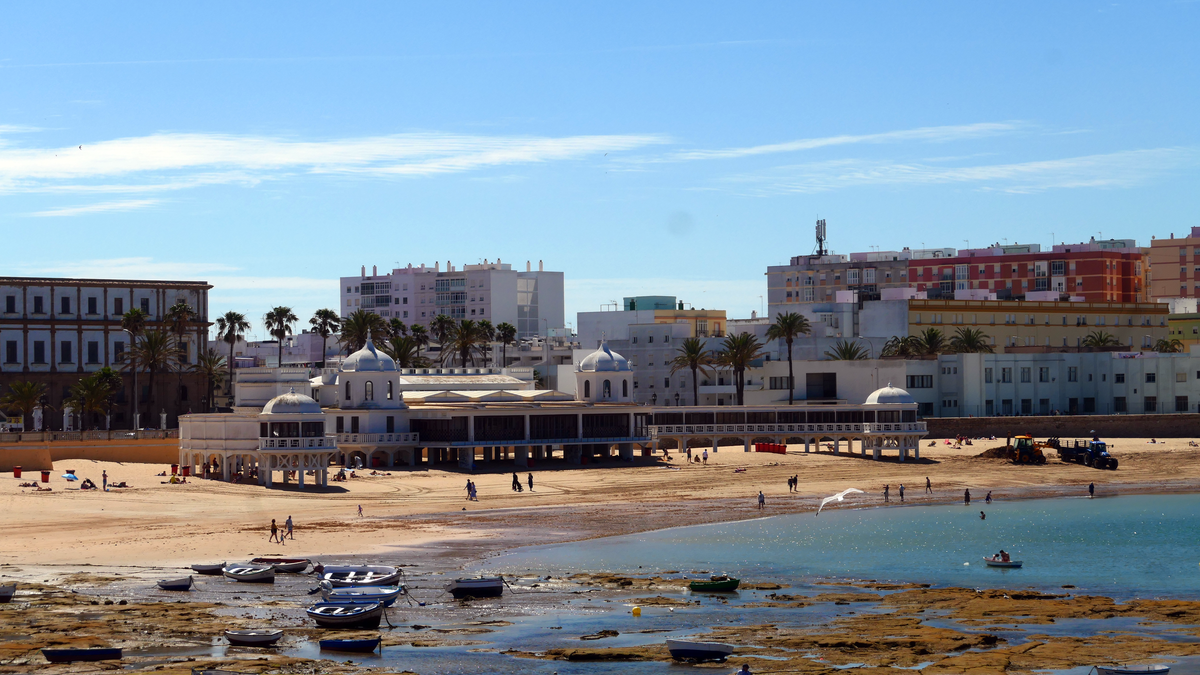
Playa de la Caleta (Cádiz city): the quintessential urban beach. Small, sheltered between two castles (Santa Catalina and San Sebastián), with the Malecón promenade on one side and the La Viña neighbourhood on the other. It’s the beach that appears in postcards of Cádiz and in more than one James Bond film.
Los Caños de Meca: golden sand beaches with low cliffs and pine trees that almost reach the sand. It has a more alternative vibe than other parts of the coast. At Cape Trafalgar — yes, the one from the battle — stands a lighthouse from which you can see the most mesmerising sunset in the province.
For more family-friendly beaches with less wind, the area of El Puerto de Santa María (Valdelagrana, La Puntilla) and Chipiona are the most recommended.
The White Villages
The Cádiz highlands are the other face of the province. As you leave the coast and head inland, the landscape changes: hills covered in holm oaks, gorges carved by rivers, griffon vultures on the cliffs, and villages that seem glued to the hillside.
Arcos de la Frontera: the most famous of Cádiz’s white villages and the gateway to the White Villages Route. The old town is perched on a limestone crag that the Guadalete River hugs on three sides. The Peña Nueva viewpoint overlooks a vertical cliff of a hundred metres from which you can take in the whole plain. The church of Santa María is Gothic-Mudéjar with a Plateresque doorway you don’t expect to find in a town of thirty thousand people.
Vejer de la Frontera: if Arcos is the most spectacular, Vejer is the most beautiful. The village rises on a hill almost two hundred metres above the Barbate River valley, just ten kilometres from the coast. The Plaza de España is one of the most beautiful main squares in Andalusia, with a central tiled fountain and centuries-old palm trees. Getting lost in Vejer’s Jewish quarter, with its arches, passageways, and hanging flowerpots, is better than visiting many major monuments.
Grazalema: inside the Sierra de Grazalema Natural Park, this village is the ideal starting point for hiking trails. The Grazalema range has the highest rainfall in the Iberian Peninsula (over two thousand litres per square metre per year), which means there are forests of Spanish fir, a prehistoric species that only grows in this range and in parts of Morocco. The Pinsapar trail is one of the most recommendable day trips in the province.
Setenil de las Bodegas: the most peculiar village in Cádiz and one of the most unique in Spain. The houses are literally embedded under an enormous travertine rock that acts as a natural roof. The streets Cuevas del Sol and Cuevas de la Sombra run beneath the suspended rock. Eating at one of the terraces under the stone, with the feeling that the ceiling will come down on you in about three or four thousand years, is a strange and recommendable experience.
The Wine Route: Jerez and Sanlúcar
The province of Cádiz is a top-tier wine region. The triangle formed by Jerez de la Frontera, Sanlúcar de Barrameda, and El Puerto de Santa María produces some of the most prestigious fortified wines in the world.
Jerez de la Frontera is known for three things: wine, horses, and flamenco. The Royal Andalusian School of Equestrian Art puts on a show called “How the Andalusian Horses Dance” that even those with no interest in horses find fascinating. The bodegas — González Byass (home of Tío Pepe), Domecq, Lustau — can be visited and the tour includes a tasting. The Cathedral and the Alcázar of Jerez round off the cultural circuit.
Sanlúcar de Barrameda, at the mouth of the Guadalquivir, is famous for manzanilla (a wine similar to fino but matured exclusively in Sanlúcar, by the sea) and for the horse races on the beach every August (the oldest horse races in Spain, declared a Festival of International Tourist Interest). Don’t miss the Sanlúcar prawns in Bajo de Guía.
What to Eat in Cádiz
Cádiz cuisine revolves around the sea. The almadraba bluefin tuna — the Iberian pig of the sea, as some chefs call it — is the absolute star.
- Almadraba bluefin tuna: the almadraba is a Phoenician artisanal fishing technique that catches tuna during their migration from the Atlantic to the Mediterranean between April and June. In those months you’ll find the different cuts of tuna in the bars of Zahara, Barbate, and Conil: parpatana, morrillo, tarantelo, descargamento. Each cut has a distinct texture and flavour.
- Tortillitas de camarones: crisp, very thin fritters made with tiny shrimp, chickpea flour, spring onion, and parsley. The best are in San Fernando and at the Central Market in Cádiz.
- Cazón en adobo: chunks of dogfish marinated in adobo (vinegar, garlic, paprika, cumin) and fried. The classic of Cádiz tapas.
- Pescaito frito: fried sea anemone, mullet, wedge sole, baby squid. In Cádiz they fry with chickpea flour instead of wheat flour, which gives a crispier, lighter result.
- Papas aliñás: boiled potatoes dressed with olive oil, vinegar, spring onion, and parsley. Simple and addictive.
When to Visit Cádiz
The province of Cádiz works all year round thanks to its climate. Winters are very mild — the average temperature in January is 12 degrees — and summers are hot but bearable thanks to the Levante and Poniente winds.
February is the month of the Cádiz Carnival, probably the most entertaining in Spain. The street chirigotas sing satirical couplets about current political and social affairs with a wit and sharp tongue that would be unthinkable in other cities. Carnival is not just the parade: it’s the whole city turned into a stage for two weeks. If you come during Carnival, book accommodation at least three months in advance.
Spring and autumn are the best times: uncrowded beaches, pleasant temperatures for hiking in Grazalema, and the spectacle of almadraba tuna in May-June.
Discover also the guides to Seville, Málaga, and Huelva, the neighbouring province with which Cádiz shares the Doñana National Park.
Frequently Asked Questions
Which is the best beach in Cádiz? It depends on what you’re looking for. Bolonia for landscape and space, Zahara de los Atunes for atmosphere and food, La Caleta for being right in the city, Los Caños for a more bohemian vibe. In Cádiz the problem isn’t finding a good beach, it’s deciding which one to rule out.
Do I need a car to explore the province? For the city of Cádiz, no. For the white villages and the beaches, yes. A car is almost essential if you want to move freely around the province.
How many days do I need to see Cádiz? For the capital, a long weekend (3 days) lets you see the main sights and enjoy the beach and terraces. To do the province at a relaxed pace — beaches, white villages, Jerez, and Sanlúcar — you need at least a week.
Is it true that it’s windy all the time in Cádiz? In the city, not particularly. In Tarifa and the beaches around the Strait, yes. The Levante wind can be annoying but it also cools things down in summer, and in Tarifa it turns the beach into a paradise for wind sports.