
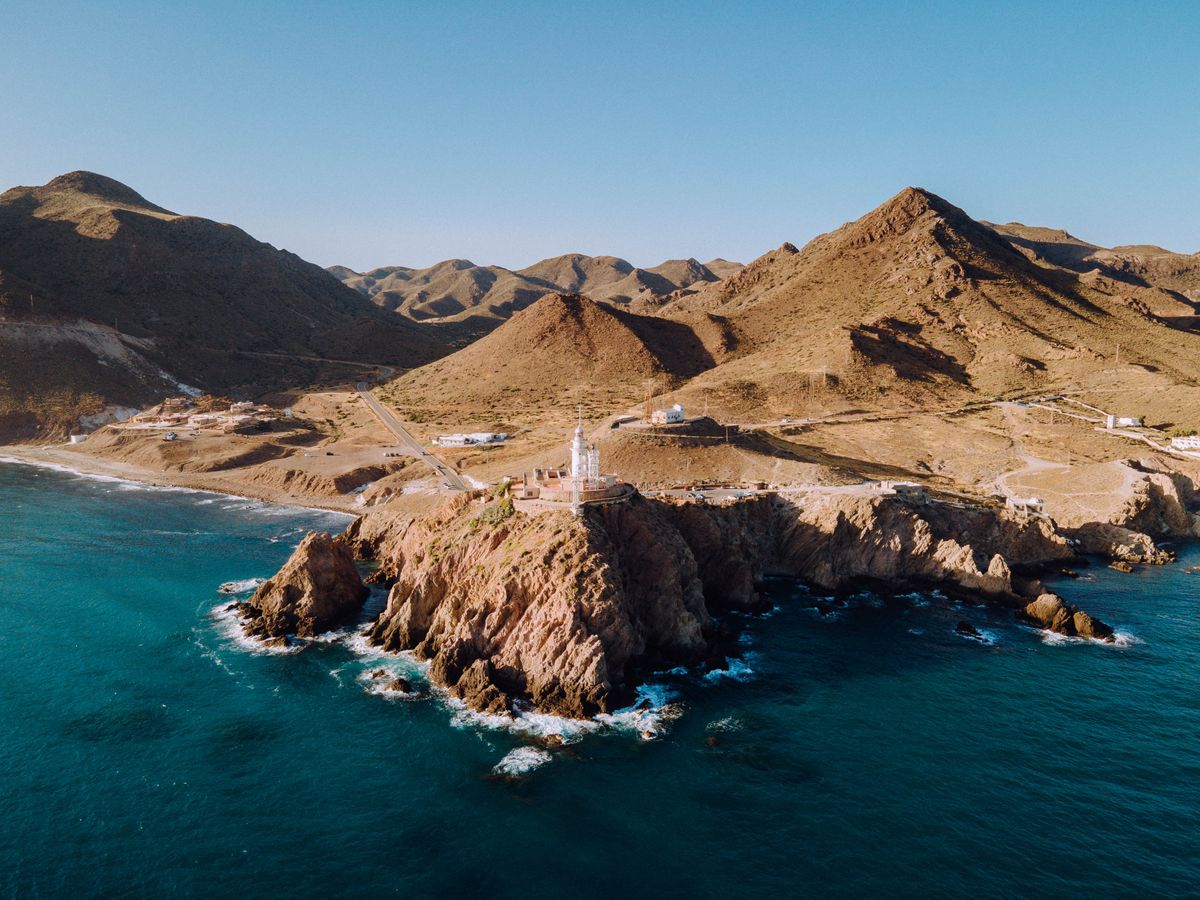
Almería Guide: Cabo de Gata, Desert, and the Alcazaba
Almería is the Andalusian province that least resembles the image most people have of Andalusia. Here there are no great Gothic cathedrals, no olive-grove plains stretching as far as the eye can see, no tourist bustle of the Costa del Sol. What there is, is a real desert, a coastal natural park with some of the cleanest beaches in the Mediterranean, and a city that was the richest port of the caliphate and is today probably the least crowded of the Andalusian capitals.
The province is the easternmost in Andalusia and the most arid in Europe. That, which sounds like a flaw, is its greatest asset: the light is different, the vegetation is different, the landscape looks more like North Africa than southern Spain. In fact, more than three hundred films have been shot here, from Sergio Leone’s spaghetti westerns to Game of Thrones and Exodus.
Cabo de Gata: The Mediterranean As It Used to Be
The Cabo de Gata-Níjar Natural Park is the largest protected coastal area in Andalusia: sixty-three kilometres of coastline with volcanic cliffs, golden-sand coves, seabeds with exceptional biodiversity, and an almost total absence of mass development.
The difference from other Spanish coasts is that here, around fifteen million years ago, there was intense volcanic activity. That created a unique landscape: petrified lava flows that spill into the sea forming black cliffs, volcanic chimneys exposed by erosion, and sand that is golden on some beaches and almost black on others.
The best beaches:
- Playa de los Genoveses: a kilometre of fine sand in an almost circular bay protected by fossil dunes. There are no chiringuitos, no paid umbrellas, nothing but the beach and the sea. In summer it fills up, and access is regulated to protect the park (limited parking — best to arrive early).
- Playa de Mónsul: volcanic black sand and an enormous solidified lava rock that emerges from the water a few metres from the shore. This rock is one of the park’s icons — it appears in Indiana Jones and the Last Crusade. In the background you can see the Mónsul reefs, a small volcanic archipelago.
- Cala de San Pedro: only reachable on foot (about two kilometres of trail from Las Negras) or by kayak. It’s a secluded cove with a community of hippies who have been living in the cliff caves since the seventies. Don’t expect comfort, but do expect a place out of the world.
- Playa de los Muertos (between Carboneras and Agua Amarga): despite the name, one of the most beautiful beaches in Almería. Crystal-clear water, polished stones instead of sand on part of the beach, and a scenic downhill path.
For fresh fish in the area, the villages of Las Negras, Agua Amarga, and La Isleta del Moro have restaurants with the catch of the day. In La Isleta del Moro, the restaurant La Ola serves seafood rice dishes with views of the port that stay with you.
The Tabernas Desert: Europe’s Only Desert
Just thirty kilometres north of the capital lies the Tabernas Desert, an expanse of badlands, ravines, and eroded hills with an average annual rainfall of less than 250 mm. This is where The Good, the Bad and the Ugly, For a Few Dollars More, and A Fistful of Dollars were filmed.
The sets from those films have been turned into Western theme parks. They’re for tourists, yes, but they’re well done:
- Mini Hollywood (Oasys) : the largest, with a live cowboy show and a small zoo.
- Fort Bravo: better preserved than Mini Hollywood, with more carefully kept original sets.
- Western Leone: smaller and less crowded, ideal if you don’t want the masses.
Between December and March, the desert transforms when the rains — scarce but timely — bring an ephemeral green carpet to the bare hills. It’s known as the “flowering desert” and it’s brief but spectacular.
The Capital: Almería City
The city of Almería is usually where people sleep in order to head to Cabo de Gata or the desert, and treating it only as a base of operations is a mistake. It has one of the most interesting monumental complexes in Andalusia that almost no one visits.
The Alcazaba of Almería is the largest Islamic fortress in Spain after the Alhambra. Built by Abd al-Rahman III in the year 955 and expanded by the Taifa king Hayran in the 11th century, it dominates the city from the Cerro de San Cristóbal. Entry is free for EU citizens. The view from the third enclosure over the La Chanca neighbourhood — whitewashed houses climbing the hillside forming a mosaic of white cubes — is one of the province’s most photogenic sights.
The Cathedral of Almería looks like a fortress because it was built in the mid-16th century with that dual function: temple and defensive refuge against Berber pirates raiding the coast. It is the only example of a cathedral-fortress in Spain. Its Gothic vaults and Renaissance ambulatory contrast with the exterior buttresses that look like those of a castle.
The Archaeological Museum of Almería is devoted to two native cultures: Los Millares (a Copper Age civilisation, 3200–2200 BC, with a fortified settlement on the outskirts of the city that can be visited) and El Argar (Bronze Age, 2200–1500 BC). The exhibition is very well presented and gives you context for why this land has been inhabited for over five thousand years.
For eating in the city, Calle Las Tiendas and its surrounding streets concentrate traditional tapas bars. Casa Puga (Calle Jovellanos, 7) is the oldest, with over a hundred years of history, a worn wooden bar, and hams hanging from the ceiling.
Almería Gastronomy
Almería’s cuisine is the most humble in Andalusia, and probably for that reason also one of the most genuine:
- Gurullos: hand-rolled pasta shaped like grains of rice, slow-cooked with rabbit, partridge, or pork ribs. A dish of pastoral origin that you hardly find outside the province.
- Migas de harina de sémola: unlike the breadcrumb migas of other parts of Andalusia, here they are made with semolina flour and served with tajás (pieces of fried meat), green peppers, anchovies, and radishes. Generous plates.
- Fresh fish from the fish market: in Almería, fish takes centre stage. Garrucha red prawns, pot-caught squid from Carboneras, jibia (cuttlefish) with onions.
- Raf tomato: grown in the greenhouses of western Almería, this thin-skinned, intensely flavoured tomato is a rarity exported across half of Europe. In its place of origin, it’s simply sliced with olive oil and salt.
When to Go to Almería
Almería has the best climate in Andalusia for tourism for almost the whole year. Winters are very mild (average 16°C in January) and summers are hot but with a sea breeze.
Spring and autumn are the best seasons: the countryside turns green, the beaches are almost empty outside weekends, and the temperatures are perfect for hiking around Cabo de Gata.
If you travel in summer, plan visits to the desert and the Alcazaba for first thing in the morning (before 11 am) and leave the afternoons for the beach or siesta. The water along the Almería coast is colder than in the rest of the Andalusian Mediterranean — the Atlantic enters through the Strait and the current cools this area — which in August is a relief.
For more Andalusian destinations, see the guides to Granada and Málaga. If you’re interested in Islamic heritage, Córdoba is a must-stop.
Frequently Asked Questions
Do I need a car in Almería? Yes, almost essential. Public transport between the villages of Cabo de Gata is limited, and for the desert there is no direct public transport.
How many days do I need? Three days minimum: one for the city and the Alcazaba, another for Cabo de Gata, and another for the desert and inland villages. If you can stretch to five, even better.
Is the Tabernas Desert worth it or is it too touristy? The Western theme parks are openly touristy, but they’re well done and kids enjoy them. The desert landscape itself is the real attraction, and you can explore the ravines and badlands without entering any theme park. That part is free.
Are the coves of Cabo de Gata safe for children? Most of them are. Los Genoveses and Mónsul have calm waters and a shallow shore. The more difficult-to-access coves (San Pedro, some in the Rodalquilar area) are less suitable with small children.
Cabo de Gata (Almería): Guía 2026 y Consejos Esenciales
El Parque Natural Cabo de Gata-Níjar en Almería constituye uno de los espacios litorales protegidos más singulares de Europa. Para maximizar la experiencia de viaje en 2026, resulta imprescindible dominar la normativa ambiental de acceso a calas protegidas, la influencia de los vientos predominantes (Levante y Poniente) y las mejores opciones de movilidad sostenible.
| Zona / Enclave | Regulación de Acceso (2026) | Protección contra Viento | Perfil Recomendado |
|---|---|---|---|
| Playa de Mónsul | Bus lanzadera desde San José o parking con cupo (aprox. 6 €) | Resguardada con viento de Poniente | Paisajes volcánicos, familias y fotografía |
| Los Genoveses | Lanzadera municipal, bici o a pie (2,5 km de pista) | Óptima con viento de Poniente | Aguas someras y senderismo botánico |
| Cala de Enmedio | Acceso a pie desde Agua Amarga (sendero de 30 min) | Protegida de brisas de Levante moderado | Snorkel, tranquilidad y senderistas |
| Arrecife de las Sirenas | Carretera directa AL-3115 hasta el Faro | Expuesto; apto para mirador y fotografía | Rutas guiadas en kayak y geología |
Consejos prácticos para recorrer Cabo de Gata en 2026
- Verifica el viento antes de salir: Los vientos determinan el estado del mar. Con Levante fuerte, opta por calas orientadas al suroeste; con Poniente, las playas de Poniente como Genoveses y Mónsul presentan aguas cristalinas como piscinas naturales.
- Gestión de accesos en temporada estival: De junio a septiembre, el acceso en vehículo privado a las calas vírgenes de San José se clausura al llenarse los aparcamientos autorizados; prioriza el servicio público de lanzaderas.
- Autonomía y preservación ecológica: Al ser un espacio natural no antropizado, la mayoría de calas carecen de papeleras, duchas o chiringuitos. Es preceptivo llevar provisión abundante de agua, escarpines para el fondo rocoso y retirar todos los residuos generados.