
Cabo de Gata Beaches: Best Beaches, Coves, Map and Where to Stay
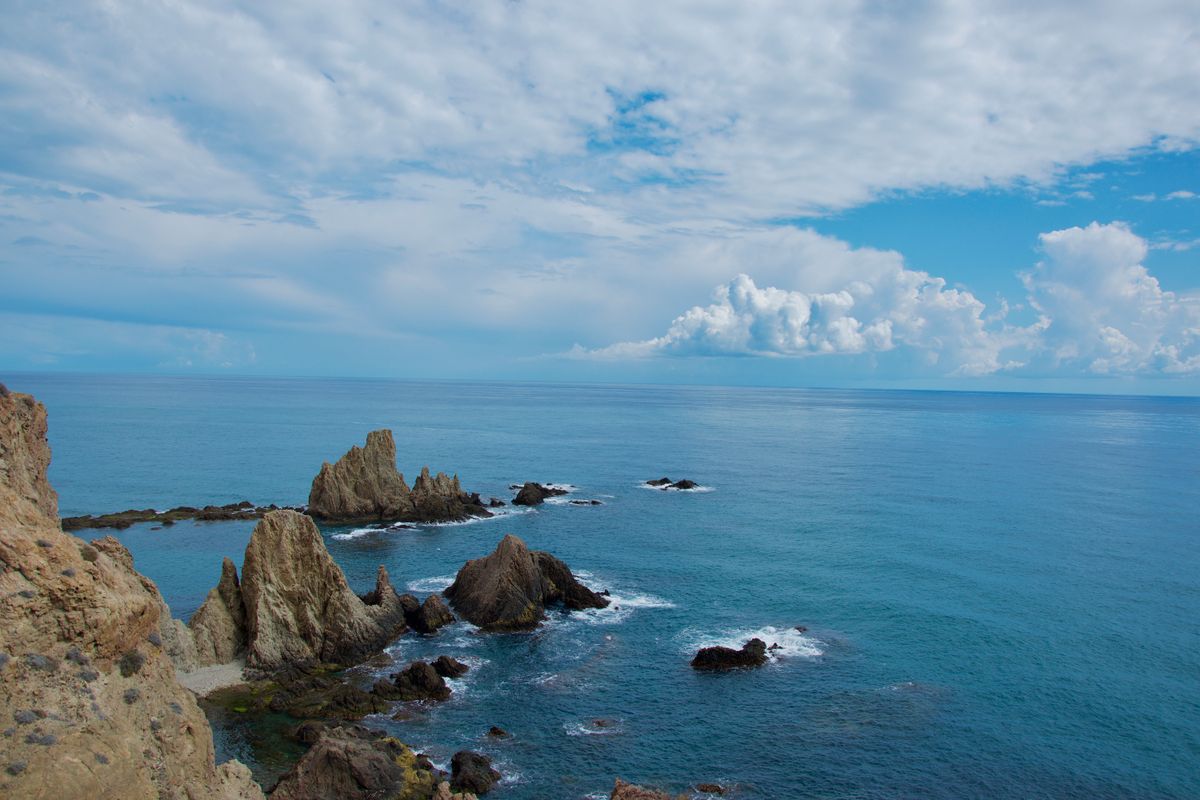
The Cabo de Gata-Níjar Natural Park boasts seventy kilometres of coastline where the hand of man has barely touched anything. There are no beachfront hotels here, no palm-lined promenades, none of the tourist infrastructure one associates with the Spanish Mediterranean. What there is: golden and black sand — a legacy of volcanic activity fifteen million years ago — cliffs of petrified lava plunging into the sea, and water so clear that on calm days it looks more Caribbean than Mediterranean.
Cabo de Gata is the driest spot in Europe. It rains less than two hundred litres a year, and what sounds like a shortcoming is precisely what saved the coast from rampant development: farming wasn’t profitable, mass tourism sought more fertile ground, and the park — declared in 1987 — froze whatever was left. This is a guide to the beaches you can’t skip, arranged north to south.
Main Beaches from North to South
Playa de los Genoveses
This is the most famous one, the one everyone wants to visit. A kilometre of fine golden sand in an almost circular bay, sheltered by fossil dunes with the silhouette of Cerro de los Frailes in the distance. The beach is open — the Atlantic pushes in as a cold current — and on days with an easterly wind the swell is strong, but on westerly or calm days it’s perfect.
Access is regulated in summer: there is a car park with limited spaces, and when it’s full they close the road. In July and August, by ten in the morning it can already be at capacity. The alternative is to leave your car in San José and walk the two-kilometre dirt track. It’s worth it: the path winds through agaves, fan palms, and prickly pears with sea views, and the walk primes your body for a swim.
There is no beach bar on the beach, no sun loungers, nothing. Bring water, food, and a parasol. The sand is fine and the seabed is sandy too, with no rocks, making it ideal for swimming.
Playa de Mónsul
Two kilometres south of Genoveses, Mónsul is the most cinematic beach in the park: scenes from Indiana Jones and the Last Crusade (Sean Connery shooing seagulls with an umbrella) and Story of a Kiss were filmed here.
Mónsul’s icon is an enormous rock of solidified lava rising from the sand a few metres from the shore, like a natural monument that erosion has sculpted into whimsical shapes. The sand is dark grey, almost black, thanks to its volcanic origin, and in summer it burns your feet until you get into the water.
Access is easier than Genoveses: there’s a dirt car park a few metres from the beach. The slope down is steep but fitted with wooden walkways. In high season it also fills up early.
The wind at Mónsul shapes a sand dune that climbs from the beach towards the cliffs. Kids roll down that dune. If you bring children, it’s unavoidable.
Cala de San Pedro
You can’t get here by car. The only way is on foot from the village of Las Negras (about two kilometres of coastal path, easy and well signposted) or by kayak from Las Negras beach. This filters out ninety percent of visitors in one go and makes San Pedro the quietest cove in the park even in August.
The cove has coarse sand and intensely blue water. In the cliffs behind there is a small community of hippies who have been living here since the 1970s, in caves dug into the rock. They plant their vegetable gardens, fish, and live on the fringes of tourism. There’s a fresh-water spring flowing from the rock and a couple of chiringuitos serving fresh fish.
San Pedro is the place you come to for the whole day. There’s no mobile phone signal. There’s nothing to do except swim, read, walk, and stare at the horizon. That’s the point.
Playa de los Muertos
It’s at the northern end of the park, between Carboneras and Agua Amarga, and despite the name — Beach of the Dead — it’s one of the loveliest on the Almería coast. The name comes from the fact that currents once washed shipwreck victims onto this shore, not because it’s dangerous for swimming.
The beach is made of polished pebbles rather than sand in some areas, with white and grey cobbles rounded by the sea over centuries. The water is exceptionally clear because there’s no suspended sand to cloud it. On calm days, the visual effect is that of a giant natural swimming pool.
Access: you need to leave your car in a parking area next to the road and descend a path of about fifteen minutes. The descent has stone steps and handrails on the steeper sections, but it’s not suitable for people with reduced mobility. From the viewpoint at the top there are views of the coastline that justify the trip even if you don’t go down to the beach.
Playa de la Media Luna and Cala del Plomo
Smaller and more hidden than the ones above, these two coves in the south of the park (near Agua Amarga) are perfect for those seeking privacy. La Media Luna is shell-shaped with fine sand. Cala del Plomo is pebbly and tends to be almost empty even in July.
Access to both is via dirt tracks. The surface is in good condition but a low-slung car may struggle on some stretches. Better to take it slow.
Villages to Sleep and Eat
San José is the most tourist-oriented village in the park and the most convenient base of operations. It has everything: supermarkets, restaurants, kayak and bike rental shops. At night, the seafront promenade fills with terrace bars.
Agua Amarga is quieter. An old fishing village turned into a discreet second-home destination. The houses are white with blue doors and windows. There are good fish restaurants along the seafront and the village beach is small but pleasant.
Las Negras is the hippie village of the park. A relaxed vibe, craft shops, bars with live music at night. The best place for fresh fish is the La Ola restaurant, with a terrace right by the sea.
Practical Tips
- A car is essential. No exceptions.
- Water and food: many beaches have no facilities. Bring what you need and take your rubbish with you.
- Sun protection: the sun here bites even when it doesn’t feel hot. The wind fools you.
- Jellyfish: in summer, jellyfish can appear on some days (especially with an easterly wind). The more sheltered coves (San Pedro, La Media Luna) tend to be spared.
- Best time: June and September are perfect. July and August are fine but busier. May and October also work, with the water a bit cooler.
If you want to know more about the province, check out the complete guide to Almería. And if you’re interested in other beach destinations in Andalusia, the guides to Cádiz and Málaga also have spectacular coastlines.
Find places to stay in Almería
Compare hotels, apartments, and stays with free cancellation on many bookings.