Almería · playas
Cabo de Gata Road Trip: The 2026 Driving Guide
El circuito completo por el Parque Natural de Cabo de Gata: parkings reales, horarios anti-masificación, gastronomía local y 7 miradores imprescindibles.
In this guide
Cabo de Gata operates on different rules from the rest of Andalusia. There are no motorway access points, no fast-food strips flanking the beach car parks, and no shuttle-bus queues. What exists instead is a single-track coastal road — the AL-3108 and its tributaries — threading through a UNESCO Biosphere Reserve where 38 kilometres of coastline remain legally unbuilt. In high summer (July–August), day-trippers from Almería city arrive in volumes that overwhelm the three main access villages before 10:00. Every logistical decision in this guide is calibrated around that single fact.
| Key Stop | Road Access | Free Parking | Best Photographic Light | Critical Warning |
|---|---|---|---|---|
| Cabo de Gata Lighthouse (Faro) | AL-3108 → AL-3108a (last 2 km unpaved) | Dirt area at Playa de la Fabriquilla, ~40 spaces | Late afternoon (17:00–19:30), south-facing cliffs catch golden hour | Road closed to private vehicles Jul–Aug on weekends after 10:00; shuttle from Las Negras not available here — walk from Fabriquilla (1.8 km) |
| Mirador de las Amatistas | AL-3108 km 14 unmarked track, 4WD recommended | None official; verge space for 6–8 vehicles | 07:00–09:00 (east-facing amethyst cliffs, sunrise backlight) | Track degrades after rainfall; check 48h forecast |
| Las Negras village | AL-3108 north branch, 12 km from Níjar on the A-7/E-15 slip | Municipal car park Calle La Caleta, free, 80 spaces | Morning (09:00–11:00) for the volcanic black headland | Only road access to Cala de San Pedro; park here and hike 45 min (2.8 km one-way, no vehicle access) |
| Playa de los Genoveses | Dirt road from San José, 4.5 km | Regulated parking at trailhead: free Oct–May; €6/day Jun–Sep | 10:00–12:00 (north-facing bay, morning fills it with soft diffused light) | Access restricted Jul 1–Sep 15: shuttle only from San José (€3 return, every 30 min, 08:00–20:00) |
| Isleta del Moro | AL-3108, directly off road, no detour | Roadside layby, 15 spaces maximum | Any time — shaded north aspect; tuna-boat boats provide scale foreground | Layby fills by 09:30 in summer; arrive before 09:00 or after 18:00 |
The Logical Route: Almería City to Las Negras, Anti-Clockwise
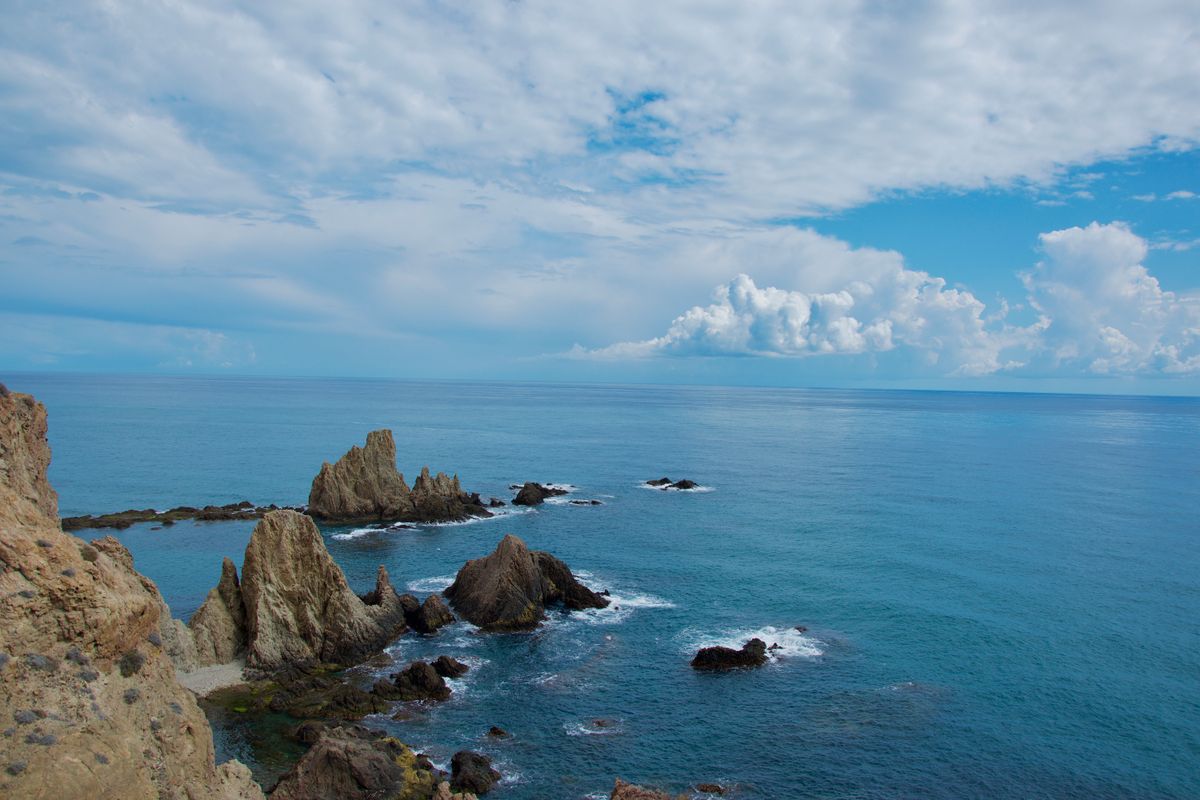
Anti-clockwise navigation — south via the AL-12 to the lighthouse, then north along the AL-3108 through San José, Agua Amarga and Las Negras — puts the sun behind you during morning drives and gives you the iconic sea-stack formations at Arrecife de las Sirenas in morning shadow (ideal for architectural photography). The clockwise alternative sends you into direct easterly glare for the first three hours.
Day 1: Almería to San José (56 km, allow 5 hours including stops)
Leave Almería on the AL-12 direction Retamar. At Ruescas, the A-7 eastbound feeds you onto the AL-12 proper. The first stop worth making is the Salinas de Cabo de Gata at km 9: 470 hectares of working saltpans and the only place in Europe where greater flamingos (Phoenicopterus roseus) overwinter in four-digit flocks. Pull into the free layby on the AL-12 westbound lane — designated Área de Observación de Aves. Do not attempt to walk onto the salt dykes; the reserve perimeter is enforced by the Junta de Andalucía environmental wardens and violations carry fines of €601–€6,000 under Ley 8/1999 de la Flora y la Fauna Silvestres de Andalucía.
The Faro de Cabo de Gata sits at the peninsula’s southernmost tip. The surfaced road ends at Playa de la Fabriquilla (free dirt parking, ~40 spaces, fills by 10:00 in summer). From there it is 1.8 km on foot along a levelled track. The lighthouse itself is not open to visitors, but the basalt reef formation of Arrecife de las Sirenas extends into the sea directly below — bring polarised lenses to cut through the water surface and reveal the rock architecture at depth.
Re-join the AL-3108 heading east and north to San José (18 km from the lighthouse turning). San José is the largest settlement in the park: population ~600 permanent residents, expanding to an estimated 8,000+ in August. The municipal car park on Calle Correos (free, 120 spaces, open 24h) is the operational base. Book accommodation here if doing two days; options are thin north of this point.
Day 2: San José to Las Negras and Agua Amarga (48 km, allow 6 hours)
The shuttle to Playa de los Genoveses departs from the San José bus stop on Avenida del Mar from 08:00. Frequency is every 30 minutes in season (June 15–September 15); the return ticket costs €3 purchased on board. The beach itself — 800 metres of coarse biogenic sand backed by Phoenician juniper — is best before 10:30, when the western headland still casts partial shadow over the southern half. Arrive at the shuttle stop by 07:45 to secure a seat on the 08:00 departure.
Returning to San José by 11:00, drive north on the AL-3108 to La Isleta del Moro. The name refers not to any island but to a tiny fishing hamlet of 60 residents whose tuna boats (almadraba cooperative, now largely defunct but the equipment remains) still define the aesthetic. Park on the verge before 09:00. The view north takes in the Cerro del Cuervo volcanic cone — the park’s most photogenic geological profile when backlit from the southwest after 16:00.
Las Negras (12 km further north) provides lunch. The municipal car park on Calle La Caleta handles 80 vehicles and is free year-round. The Cala de San Pedro hike (2.8 km one-way, 45 minutes, no shade for the first kilometre) leads to a beach with a crumbling 16th-century Castillo de San Pedro and a semi-permanent community of approximately 30 people living off-grid — a genuinely unusual social geography nowhere else replicated on the Spanish Mediterranean coast.
The route ends at Agua Amarga (16 km from Las Negras via the AL-3108 and a brief stretch of the ALP-816). A quieter settlement than San José, it has a single paved main street, three restaurants and a beach that faces northeast — making it the only spot in the park where you can watch the sun rise directly over the sea.
Against the Crowds: Operational Timing and Photography Windows
- Peak heat avoidance: July and August temperatures at midday regularly exceed 38°C on the volcanic basalt surfaces. The coastal track lacks shade for 90% of its length. Any walking section should conclude before 11:30 or begin after 18:00.
- Photography — east coast south-facing cliffs: Golden hour lands 45 minutes before sunset. In October 2026, sunset times at Cabo de Gata range from 19:52 (October 1) to 19:02 (October 31). The amethyst-coloured cliffs near La Isleta del Moro photograph best at 17:30–19:00.
- Weekend vehicle bans: The Junta de Andalucía restricts private vehicle access on the AL-3108 between the Faro junction and San José on Saturdays and Sundays from June 15 to September 15, between 09:00 and 20:00. Shuttle service (Autobuses Becerra, line AL-117) operates from San José village to the Faro access point every 45 minutes, €2.50 single.
- Alternative to Genoveses: Cala Monsul (3.2 km south of San José on foot, no vehicle access) receives roughly one-tenth of Genoveses’s visitor numbers yet has the same volcanic boulder formation and cleaner water columns per the Junta’s annual bathing water quality report (2025 classification: Excellent, Directiva 2006/7/CE).
Authentic Gastronomy: Beyond the Chiringuito Circuit
What grows and swims here
The semi-arid hinterland of Níjar — Cabo de Gata’s administrative municipality — produces three products of genuine local distinction. Tomate de Níjar is a rough-skinned, high-Brix heritage tomato variety grown without irrigation supplementation; it appears on menus from mid-July and is sold by weight at the Cooperativa Agrícola de Níjar on the N-344. Pimentón de la Vera does not apply here — the local smoked paprika tradition is different and informal, tied to the drying of ñoras (round dried peppers) in domestic courtyards in Níjar town. The olive oil of the Tabernas basin (DOP Poniente de Granada covers part of this territory) is a single-variety Hojiblanca pressing with notably low acidity (≤0.3% in 2024 production).
Dishes worth ordering by name
- Gurumelos con huevos revueltos: Wild milk thistle mushrooms scrambled with free-range eggs, available only in spring (March–May). Ask at Bar Restaurante La Palma in Las Negras.
- Mojama de atún: Salt-cured yellowfin tuna loin, sliced paper-thin and dressed with the local Hojiblanca oil. The version produced by Conservas Herpac in Carboneras (18 km north) is the benchmark; it appears on menus across the park.
- Pulpo a la plancha con pimentón: Grilled octopus with local paprika — available at El Ancla in San José and at La Paloma in Agua Amarga. Neither establishment has a website; both require physical reservation.
- Migas de pastor: Breadcrumb-based dish cooked with olive oil, garlic, ñoras and sardines or chorizo — the inland shepherd’s staple now served as a local curiosity at weekend markets in Níjar.
Avoid any beachfront menu advertising paella mixta as a signature dish — this is the park’s most reliable indicator of a kitchen that is not engaging seriously with local product.
Fuentes Primarias y Referencias Oficiales
- Junta de Andalucía — Plan de Uso Público del Parque Natural Cabo de Gata-Níjar, Decreto 37/2008 (BOJA núm. 36, 20 febrero 2008), modificado por Decreto 98/2014.
- Junta de Andalucía, Consejería de Sostenibilidad — Resolución de 14 junio 2023 por la que se regula el acceso rodado estacional en la AL-3108 (BOJA núm. 115).
- Directiva 2006/7/CE del Parlamento Europeo relativa a la gestión de la calidad de las aguas de baño — clasificación “Excelente” Playa de los Genoveses y Playa de Mónsul, informe Junta de Andalucía 2025.
- Ley 8/1999, de 27 de octubre, de Espacios Naturales de Andalucía — régimen sancionador, artículo 82 (infracciones graves, rango €601–€6.000).
- Autobuses Becerra S.L. — Concesión de transporte público AL-117 (San José–Faro de Cabo de Gata), Consejería de Fomento de la Junta de Andalucía, vigencia 2024–2029.
- Cooperativa Agrícola de Níjar — Producción certificada de Tomate de Níjar, ficha de producto depositada en el Registro de Variedades Comerciales del MAPA (Ministerio de Agricultura, Pesca y Alimentación), ref. RVC-2019-0441.
- Instituto Nacional de Meteorología (AEMET) — Climatología de referencia Estación Almería Aeropuerto (indicativo 6325O), serie 1991–2020.
Frequently asked questions
¿Se puede aparcar gratis en el Parque Natural de Cabo de Gata?
Sí, existen parkings públicos gratuitos en Las Negras (Calle La Caleta, 80 plazas, abierto todo el año), en San José (Calle Correos, 120 plazas) y en el área de Fabriquilla junto al acceso al faro (superficie de tierra, ~40 plazas). Entre el 1 de junio y el 15 de septiembre, el parking del camino a Playa de los Genoveses pasa a ser de pago (6 €/día) y el acceso se regula mediante lanzadera desde San José.
¿Cuándo cierran las carreteras de Cabo de Gata a los coches privados?
La Junta de Andalucía restringe el acceso privado en la AL-3108 entre la desviación al Faro y San José los sábados y domingos de 15 de junio al 15 de septiembre, de 09:00 a 20:00. Durante ese horario existe lanzadera operada por Autobuses Becerra (línea AL-117) con frecuencia de 45 minutos desde San José, al precio de 2,50 € el trayecto.
¿Cuál es la mejor época del año para visitar Cabo de Gata en coche?
Septiembre, octubre y mayo son los meses óptimos: temperatura máxima media entre 24–29 °C, sin restricciones de acceso rodado, mayor disponibilidad de parkings gratuitos y luz fotográfica de calidad durante más horas. El verano (julio–agosto) es viable pero exige salida antes de las 9:00 para acceder a los puntos más demandados, y obliga a planificar en torno a las restricciones de circulación.
¿Hace falta reservar entradas para visitar el Parque Natural de Cabo de Gata?
No existe sistema de entradas para el parque en general. Sin embargo, el acceso a Playa de los Genoveses y Playa de Mónsul en temporada alta (15 junio–15 septiembre) está limitado a usuarios del servicio de lanzadera: el billete (3 € ida y vuelta) se compra directamente al conductor. No hay reserva previa digital para el transporte.
¿Qué platos típicos se deben probar en Cabo de Gata?
Los tres referentes gastronómicos son: mojama de atún (atún en salazón curado, de Conservas Herpac en Carboneras), tomate de Níjar (variedad autóctona de temporada, julio–septiembre) y pulpo a la plancha con pimentón en establecimientos locales como El Ancla (San José) o La Paloma (Agua Amarga). Las migas de pastor y los gurumelos con huevos revueltos son especialidades estacionales de gran valor etnogastronómico.
Related articles
Almería
The Alcazaba of Almería: The Great Citadel
Guide to the Alcazaba of Almería: the largest Islamic fortress in Spain after the Alhambra. History, practical visit, opening hours, and how to get there.
Almería
Cortijo del Fraile: The Story Behind Lorca’s Play
El Cortijo del Fraile in Níjar: the 1928 crime that inspired Lorca's Blood Wedding, its history as a Site of Cultural Interest, and its state of neglect.
Almería
Best Beaches in Cabo de Gata: Coves & Map Guide
Complete guide to Cabo de Gata beaches: Genoveses, Mónsul, and Los Muertos. Driving access, parking rules, snorkeling tips, and beach towns.
Find places to stay in Almería
Compare hotels, apartments, and stays with free cancellation on many bookings.
Affiliate link: if you book through it we earn a commission, at no extra cost to you.